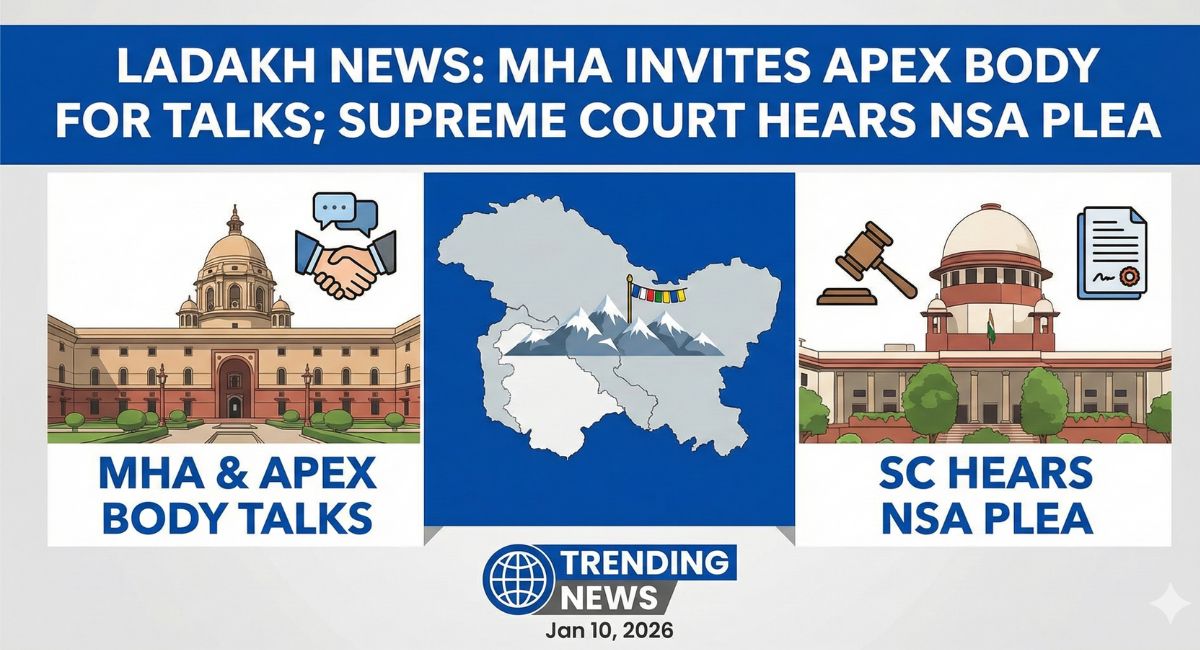
Leh/New Delhi: In a major development for the Union Territory of Ladakh, the Ministry of Home Affairs (MHA) has officially decided to resume dialogue with Ladakhi leaders. After months of tension and stalled negotiations following the violent protests of late 2025, the Centre has reached out to the High-Powered Committee (HPC) for a fresh round of talks in the last week of January 2026.
This comes at a critical time when the Supreme Court of India is actively hearing the plea against the detention of climate activist Sonam Wangchuk. Here is a detailed breakdown of the latest updates, the demands on the table, and the legal battle unfolding in the capital.
Centre Invites Ladakh Leaders for Talks
The Ministry of Home Affairs, in a letter sent to the Ladakh Chief Secretary on January 8, 2026, confirmed that the next meeting of the High-Powered Committee (HPC) will be convened in the “last part of January.”
- The Invite: The MHA has asked the Ladakh administration to coordinate with the members of the HPC—which includes representatives from the Leh Apex Body (LAB) and the Kargil Democratic Alliance (KDA)—to finalize a convenient date.
- Background: The last official meeting took place on October 22, 2025. Since then, there has been a deadlock, worsened by the violent clashes in September 2025 that resulted in four deaths and numerous injuries.
- Reaction: Ladakh leaders have welcomed the move, though some called it “late.” Sajjad Kargili of the KDA expressed hope that the meeting would substantively address their core demands rather than just being a formality.
The “4-Point” Demands of Ladakh
The talks are expected to revolve around the four non-negotiable demands raised by the LAB and KDA, which they submitted in a 29-page draft proposal to the Centre in November 2025:
- Statehood: Full statehood for Ladakh, moving away from its current Union Territory status.
- Sixth Schedule: Inclusion under the Sixth Schedule of the Constitution to protect the land, culture, and jobs of the tribal population.
- Job Recruitment: A separate Public Service Commission (PSC) for Ladakh to speed up government job recruitment.
- Parliamentary Seats: Two separate Lok Sabha seats—one for Leh and one for Kargil.
Sonam Wangchuk & Supreme Court Hearing
Parallel to the political talks, a high-profile legal battle is underway in the Supreme Court regarding the detention of education reformer and activist Sonam Wangchuk.
- Current Status: Wangchuk has been detained under the stringent National Security Act (NSA) following the September 2025 protests. He is currently lodged in Jodhpur Central Jail.
- Court Proceedings: On January 7-8, 2026, a Supreme Court bench headed by Justice Aravind Kumar heard arguments challenging his detention. Senior Advocate Kapil Sibal, representing Wangchuk’s wife, argued that the detention was “malicious” and that key evidence—videos of Wangchuk appealing for peace—was suppressed from the detaining authority.
- Next Steps: The court has deferred the hearing to allow the judges to examine the case records thoroughly. Ladakh leaders have made “general amnesty” for Wangchuk and other detained protesters a key condition for the success of the upcoming talks.
New Twist: A Third Group Enters?
Adding a new layer of complexity, a newly formed group called the “Voice of Buddhist Community of Ladakh” (VBL) has written to Home Minister Amit Shah.
- They claim that the current representatives (LAB and KDA) do not fully represent the Buddhist community’s interests.
- The VBL opposes the demand for full statehood, fearing it might skew power dynamics, and instead supports a strong Union Territory model with legislative powers.
- Existing leaders have dismissed VBL as a “self-styled” group without a public mandate, accusing the Centre of trying to create a divide.
Why This Matters for India
Ladakh is strategically vital, sharing sensitive borders with both China and Pakistan. The continued unrest in a border region is a security concern for New Delhi. The Centre is keen to stabilize the region, but it faces a tough balancing act between granting autonomy and maintaining direct federal control.
What Happens Next?
All eyes are now on the last week of January 2026.
- If the talks succeed, it could lead to a historic constitutional roadmap for Ladakh.
- If the talks fail or if the Supreme Court denies relief to Wangchuk, protests could re-ignite in the spring.
Frequently Asked Questions (FAQs)
Q1: Why are Ladakh leaders protesting against the Centre?
They are demanding Statehood and inclusion under the Sixth Schedule to protect their land, jobs, and unique tribal culture from outsiders.
Q2: Who is Sonam Wangchuk and why is he in jail?
Sonam Wangchuk is a famous educationist and climate activist. He was detained under the National Security Act (NSA) after violent protests broke out in Ladakh in September 2025.
Q3: What is the Sixth Schedule?
It is a special provision in the Indian Constitution that allows tribal areas to have Autonomous District Councils (ADCs) with powers to make laws on land, forest, and local customs.
Q4: When is the next meeting between Ladakh leaders and the Home Ministry?
The meeting is scheduled to be held in the last week of January 2026.
Q5: Who represents Ladakh in these talks?
The talks are led by the High-Powered Committee (HPC), which includes members from the Leh Apex Body (LAB) and the Kargil Democratic Alliance (KDA).