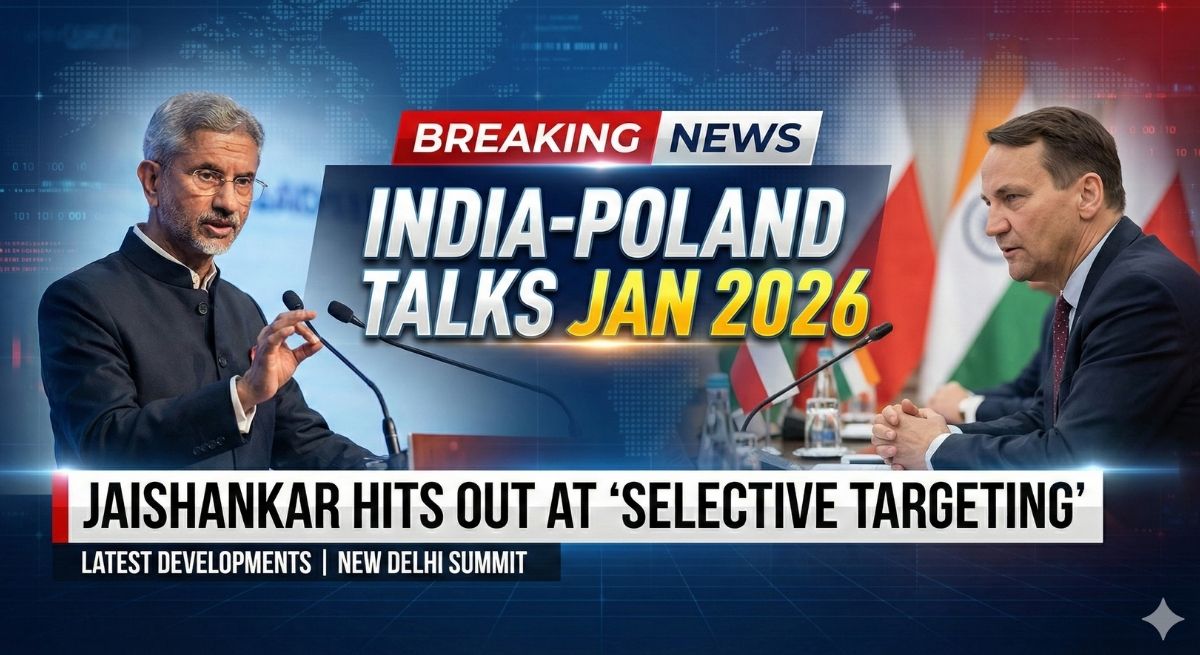
Introduction In a significant diplomatic development in New Delhi this week, India’s External Affairs Minister Dr. S. Jaishankar delivered a sharp and clear message to Poland regarding national security. During a meeting with Poland’s Deputy Prime Minister and Foreign Minister Radosław Sikorski on January 19, 2026, Dr. Jaishankar openly urged Warsaw to adopt a “zero-tolerance” policy towards terrorism and avoid actions that legitimize the “terror infrastructure” in India’s neighborhood. Here is a detailed look at why this statement was made, the background involving Pakistan, and the key outcomes of this high-profile visit.
The Strong Message: “Zero Tolerance”
The meeting at Hyderabad House was not just a routine exchange of pleasantries. In his televised opening remarks, Dr. Jaishankar addressed the Polish Foreign Minister directly regarding the security situation in South Asia.
- The Quote: “Poland should display zero-tolerance for terrorism and not help fuel the terrorist infrastructure in our neighbourhood.”
- The Context: This blunt remark is seen as a response to Mr. Sikorski’s visit to Pakistan in October 2025. During that trip, a joint statement between Poland and Pakistan referenced the “Jammu and Kashmir dispute” and called for peaceful resolutions, a move that New Delhi viewed as unnecessary interference and a validation of Pakistan’s narrative.
- Jaishankar’s Stance: By using the phrase “fuel the terrorist infrastructure,” India signaled that any diplomatic support to Pakistan—without holding it accountable for cross-border terrorism—is unacceptable.
Trade Wars & “Selective Targeting”
Beyond security, the two leaders discussed the unfair economic pressure India faces from the West.
- Russian Oil & Tariffs: Dr. Jaishankar criticized the “selective targeting” of India by Western nations (referring to US/EU tariffs and criticism over India buying Russian oil). He termed this scrutiny “unfair and unjustified.”
- Poland’s Surprise Agreement: Interestingly, Mr. Sikorski agreed with Jaishankar on this point. He admitted that Poland, too, has faced “unfair tariffs” and trade barriers recently. He noted that such “selective targeting” could lead to global trade turbulence, signaling a shared frustration with certain Western economic policies.
Strategic Partnership: Business as Usual
Despite the frank exchange on politics, the economic bond between India and Poland remains strong. The visit focused on the Action Plan 2024-28, which aims to boost the Strategic Partnership established during PM Modi’s visit to Poland in August 2024.
Key Economic Highlights:
- Bilateral Trade: Trade between the two nations has reached $7 billion, growing by nearly 200% in the last decade.
- Indian Investments: Indian companies have invested over $3 billion in Poland, creating thousands of jobs.
- Future Cooperation: The leaders discussed expanding ties in defense, clean technology, and digital innovation.
The Ukraine Factor: A Point of Difference
While they agreed on trade, differences over the Russia-Ukraine war persisted.
- Poland’s Concern: Mr. Sikorski expressed concern over India participating in the “Zapad” military exercises with Russia, calling them “threatening.”
- India’s Reply: India maintained its neutral stance, emphasizing that it has always advocated for dialogue and diplomacy, while rejecting any “selective” criticism of its foreign policy choices.
Frequently Asked Questions (FAQs)
1. Why did Jaishankar warn Poland about terrorism?
This was likely a response to Poland’s Foreign Minister visiting Pakistan in late 2025 and issuing a joint statement that mentioned Kashmir. India wanted to remind Poland that engaging with Pakistan without addressing cross-border terrorism is problematic.
2. Who is Radosław Sikorski?
Radosław Sikorski is the Deputy Prime Minister and Minister of Foreign Affairs of Poland. He visited India in January 2026 to discuss trade and the strategic partnership.
3. What is the trade volume between India and Poland?
As of 2026, the bilateral trade stands at approximately $7 billion.
4. Did Poland agree with India on any issues?
Yes. Poland agreed with India that “selective targeting” through tariffs and trade barriers is unfair. Mr. Sikorski also condemned terrorism, citing recent sabotage attempts on Polish railways.
5. What is the “Action Plan 2024-28”?
It is a strategic roadmap agreed upon by India and Poland to boost cooperation in defense, trade, and technology over four years.