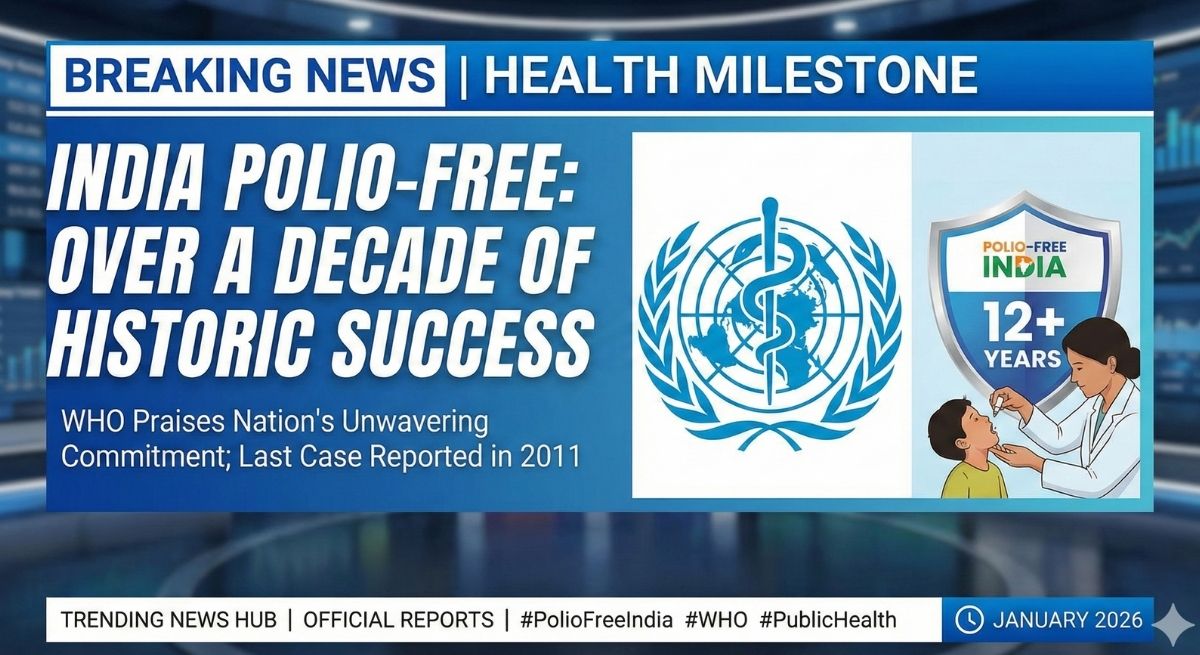
In a historic milestone for public health, India has successfully completed 15 years without a single case of wild poliovirus. The World Health Organization (WHO) and public health experts across the globe have lauded this achievement, calling it a testament to India’s robust immunization infrastructure and relentless surveillance.
Marking this significant anniversary in January 2026, the WHO South-East Asia Regional Office emphasized that India’s victory over polio continues to guide global health strategies.
The Milestone: A Journey from ‘Epicenter’ to ‘Polio-Free’
Until 2009, India was home to nearly half of the world’s polio cases and was considered the most difficult place to end the disease due to high population density and sanitation challenges.
- The Last Case: India reported its last case of wild poliovirus on January 13, 2011, in Howrah, West Bengal.
- The Certification: Three years later, in 2014, the WHO officially certified India (and the entire South-East Asia Region) as “Polio-Free.”
- Current Status: As of January 2026, the country has maintained this status for a decade and a half, silencing critics who once believed eradicating the virus in India was impossible.
WHO’s Statement on the Achievement
The World Health Organization has highlighted that while the virus has been eradicated, the “legacy” of the polio program is what matters now. In a recent statement, WHO officials noted that the Polio Surveillance Network is currently being used to fight other diseases.
“The lessons from India’s polio campaign are now driving broader public health gains,” a WHO representative stated. The vast network of health workers, monitoring systems, and cold-chain logistics created for polio is now instrumental in India’s battle against Measles, Rubella, and even Tuberculosis (TB).
Read more: US SEC Seeks
Why This Matters Now?
Remaining polio-free requires constant vigilance. Although India is safe, the virus still exists in neighboring nations like Pakistan and Afghanistan.
- Risk of Importation: There is always a risk of the virus re-entering through travel.
- Continued Surveillance: To prevent this, India continues to conduct Environmental Surveillance—testing sewage samples in major cities to detect any silent presence of the virus.
- Vaccination Drives: The government continues to hold National Immunization Days (NIDs) to ensure every newborn remains protected.
Updates: New Focus on TB and Routine Immunization
With polio firmly under control, the WHO and the Government of India are shifting the focus of this massive health machinery:
- TB Elimination: The “Polio Network” is now assisting in the National TB Elimination Programme, helping with data validation and patient tracking in states like Bihar and Uttar Pradesh.
- Zero-Dose Children: A new initiative is underway to reach “zero-dose” children (those who have missed all vaccines) in remote tribal areas of Meghalaya and Arunachal Pradesh.
What Happens Next?
The Ministry of Health and Family Welfare has reiterated its commitment to maintaining high immunity levels. Parents are urged to continue administering the “Do Boond Zindagi Ki” (Two Drops of Life) to children under five years of age during the upcoming Pulse Polio drives.
The 15-year milestone is not just a victory date; it is a reminder that with consistent effort, even the most daunting health challenges can be overcome.
Frequently Asked Questions (FAQs)
Q1: When was the last case of polio reported in India?
The last case of wild poliovirus in India was reported on January 13, 2011, in the Howrah district of West Bengal.
Q2: Is India completely safe from polio now?
Yes, India is certified polio-free. However, the risk of the virus coming from other countries remains, so vaccination drives continue to maintain immunity.
Q3: What role does WHO play in India’s polio program?
WHO provides technical support, monitors surveillance data, and helps the government plan vaccination campaigns to ensure no child is missed.
Q4: Why are polio drops still given if India is polio-free?
Polio drops are still necessary to maintain “herd immunity.” As long as the virus exists anywhere in the world, Indian children need protection against potential infection from travelers.
Q5: What is the “Polio Legacy” in India?
The “Polio Legacy” refers to using the staff, laboratories, and systems built for polio eradication to now fight other diseases like Tuberculosis (TB), Measles, and COVID-19.