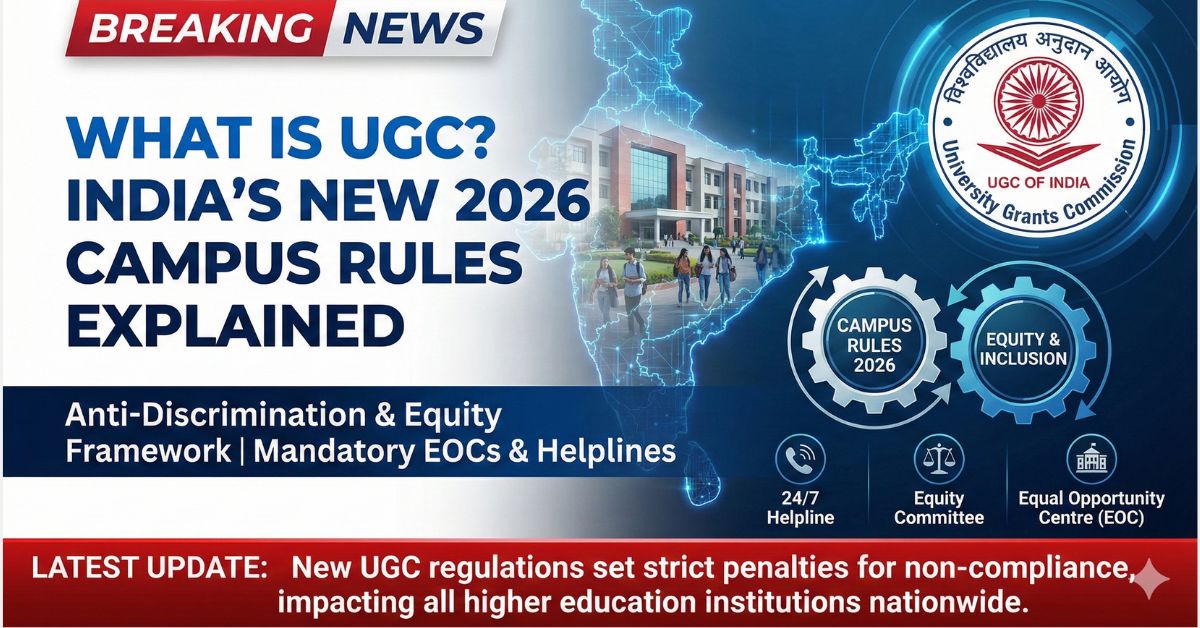
If you are a student, parent, or job aspirant in India, you have likely seen “UGC” flashing in the news headlines this January 2026. From releasing a new list of Fake Universities to notifying strict Anti-Discrimination Regulations, the UGC is currently the most talked-about body in Indian education.
But what exactly is UGC? Is it just about exams, or does it control your college degree?
Here is a simple, expert breakdown of the University Grants Commission (UGC), its full power, and why it is trending right now in 2026.
What is UGC? (Full Form & Definition)
UGC stands for University Grants Commission.
It is a statutory organization set up by the Government of India in 1956 under the UGC Act, 1956. Operating under the Ministry of Education, it is essentially the “Boss of Universities” in India.
Think of it as the RBI of Education. Just as the RBI regulates banks, the UGC regulates universities. If a university is not recognized by the UGC, its degrees are essentially worthless for government jobs or higher studies abroad.
Read more: Alex Pretti News
Why is UGC Trending in January 2026?
The UGC is making headlines this week for two major reasons:
- New Anti-Discrimination Rules 2026: On January 14, 2026, the UGC notified the “Promotion of Equity in Higher Education Institutions Regulations, 2026.” These new rules mandate every college to set up an “Equal Opportunity Cell” to prevent discrimination against SC, ST, and OBC students.
- Fake Universities List: The UGC recently released its updated 2026 warning list of “Fake Universities” operating in India, warning students not to take admission in them.
Top 5 Functions of UGC
The UGC does much more than just release notices. Its main powers include:
1. Providing Recognition
UGC determines whether a university is “Real” or “Fake.” It grants the status of “Central University,” “State University,” or “Deemed-to-be University.”
2. Disbursing Funds (Grants)
As the name suggests (“Grants Commission”), it distributes money from the Central Government to eligible universities for development, research, and infrastructure.
3. Setting Standards (NET Exam)
The UGC sets the minimum standard for hiring professors. It conducts the famous UGC-NET (National Eligibility Test) twice a year (via NTA) to determine who is eligible to become an Assistant Professor or receive a Junior Research Fellowship (JRF).
4. Regulating Fees & Curriculum
It stops colleges from overcharging students and ensures that the syllabus across India remains updated (like the recent push for the Four-Year Undergraduate Programme under NEP 2020).
5. Monitoring Ragging & Grievances
It runs the Anti-Ragging Helpline and the new Samadhaan Portal where students can complain if colleges withhold their original certificates or refuse refunds.
UGC vs AICTE: What’s the Difference?
Many students get confused between these two. Here is the simple difference:
- UGC: Regulates General Universities (Arts, Science, Commerce, Humanities). It oversees the entire university system.
- AICTE: Stands for All India Council for Technical Education. It specifically regulates Technical Colleges (Engineering, MBA, Pharmacy, Architecture).
- Note: A technical college is often affiliated with a UGC-recognized university but approved by AICTE.
How to Check if Your University is UGC Approved?
Before taking admission in 2026, follow these steps:
- Go to the official website: www.ugc.ac.in.
- Click on the “Universities” tab.
- Check the “Consolidated List of Universities.”
- If your university is on the “Fake Universities” list, avoid it immediately.
Frequently Asked Questions (FAQs)
Q1: What is the full form of UGC?
UGC stands for University Grants Commission.
Q2: Is a degree valid without UGC approval?
No. In India, only a university established under an Act of Parliament or State Legislature and recognized by the UGC can award valid degrees (like BA, B.Tech, MBA). Private institutes not recognized by UGC cannot grant degrees.
Q3: Who is the current Chairman of UGC?
As of January 2026, Prof. M. Jagadesh Kumar continues to lead the UGC, driving major reforms like the CUET and NEP implementation.
Q4: What are the new UGC Regulations 2026?
The 2026 regulations focus on “Promotion of Equity.” They mandate strict action against caste-based discrimination and require colleges to appoint an “Ombudsperson” to handle student complaints.
Q5: Does UGC conduct the NET exam?
The UGC sets the syllabus and standards for the NET exam, but the actual testing is conducted by the National Testing Agency (NTA) on behalf of the UGC.