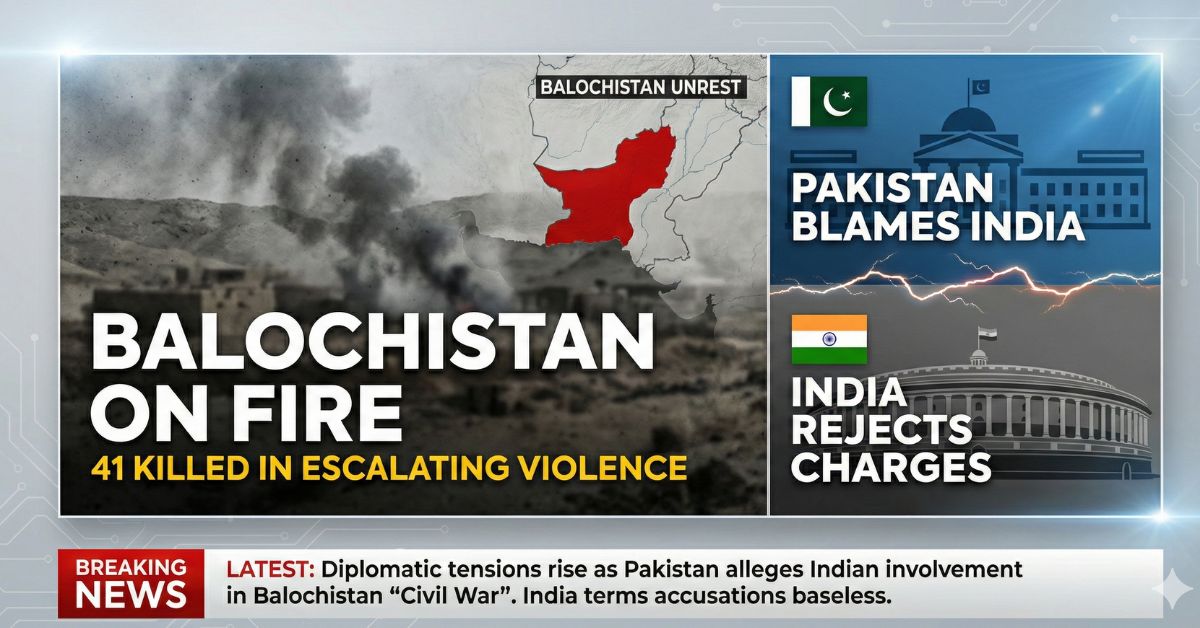
Balochistan is trending in India today because of a massive spike in violence right next door. In a deadly 24-hour window, Pakistani military forces clashed with rebels, leaving over 41 dead. As the region plunges deeper into what looks like a civil war, Pakistan has once again pointed fingers at India, accusing New Delhi of funding the chaos. Here is everything you need to know about the situation, why it is escalating, and what it means for India.
What Just Happened? (January 2026 Update)
The situation in Balochistan has turned violent and bloody. On January 30, 2026, the Pakistani military launched major operations in the Panjgur and Harnai districts.
According to Pakistan’s military media wing (ISPR), security forces raided suspected hideouts of separatist groups. The result was a fierce gun battle.
- 41 Militants Killed: The Pakistani army claims to have killed 41 “terrorists” in these raids.
- Targeted Groups: The operations targeted the Baloch Liberation Army (BLA) and other separatist factions who demand independence from Pakistan.
- Bank Robberies & Attacks: The military stated these groups were involved in attacking security convoys and looting banks to fund their operations.
This is one of the deadliest days in the province in recent months. The sheer number of casualties shows that the insurgency is not slowing down—it is getting more organized and dangerous.
Pakistan’s “India Blame Game”
Whenever violence erupts in Balochistan, Pakistan’s government blames India. This time is no different.
The Pakistani military officially used the term “Fitna-al-Hindustan” (Mischief of India) to describe these rebel groups. They alleged that the militants killed in Panjgur were “India-sponsored” and were using Indian funding to destabilize Pakistan.
The Reality: India has strongly and consistently denied these accusations. India maintains that the violence in Balochistan is a result of Pakistan’s own failed policies, human rights violations, and neglect of the Baloch people. However, the “foreign hand” narrative is a common tool used by Islamabad to distract its public from internal security failures.
Read more: Scott Bessent Blasts EU-India Deal
Why is Balochistan Fighting Pakistan?
To understand the violence, you must understand the anger. Balochistan is Pakistan’s largest province by land but its poorest by development. It is rich in natural resources like gas, copper, and gold, yet the local people live in extreme poverty.
- Resource Exploitation: Locals believe Pakistan (specifically the Punjab province) steals their resources and gives nothing back.
- Independence Movement: For decades, groups like the BLA and the Majeed Brigade have fought for a separate nation—a “Republic of Balochistan.”
- CPEC Targeting: Rebels frequently attack Chinese engineers and projects (part of the China-Pakistan Economic Corridor) because they view China as a partner in their exploitation.
The “Vast Prison”: A Human Rights Crisis
Beyond the gunfights, there is a silent humanitarian crisis. A recent report by the Baloch Yakjehti Committee (BYC) shocked the world by calling Balochistan a “vast prison.”
The report highlights:
- Enforced Disappearances: Thousands of young Baloch men, students, and activists have gone missing. Families allege they are picked up by Pakistani intelligence agencies and never seen again.
- Kill and Dump: Bodies of missing persons are often found dumped in remote areas.
- Protest Crackdowns: Peaceful protests led by women and families of the missing are frequently crushed with force.
Why This Matters to India
Even though this is happening across the border, it is critical for India for three reasons:
- Security Accusations: Pakistan uses these attacks to build a false narrative against India on global platforms like the UN.
- China’s Headache: The attacks threaten the CPEC project, which passes through Pakistan-occupied Kashmir (PoK)—territory that belongs to India. If CPEC fails due to local resistance, it is a major geopolitical shift.
- Regional Stability: A destabilized Pakistan with loose control over its borders can lead to more terrorism spilling over into the region.
What Happens Next?
The conflict is likely to get worse before it gets better.
- More Military Operations: The Pakistani army has vowed to continue its “sanitization operations” to wipe out insurgents.
- Rebel Retaliation: The BLA has a history of striking back after suffering losses, often targeting major cities like Karachi or high-profile Chinese assets.
- Diplomatic Tension: Relations between India and Pakistan will remain frosty as Islamabad continues to use the “India card” to explain its domestic chaos.
Frequently Asked Questions (FAQs)
Q1: What is the Baloch Liberation Army (BLA)?
The BLA is the most active separatist group in Balochistan. They are fighting for total independence from Pakistan. The US and Pakistan have designated them as a terrorist organization.
Q2: Is India actually helping Baloch rebels?
No. India denies all such claims. While India has expressed sympathy for the human rights violations in Balochistan, there is no evidence of military or financial support for the rebels.
Q3: Where is Balochistan located?
It is the southwestern province of Pakistan, bordering Iran and Afghanistan. It covers nearly 44% of Pakistan’s landmass but has a very small population.
Q4: Why are Chinese people attacked in Balochistan?
Rebels believe China is helping Pakistan steal Balochistan’s gold and gas resources through the CPEC project. They attack Chinese workers to scare investors away.
Q5: What is the “Majeed Brigade”?
The Majeed Brigade is a special “suicide squad” within the BLA. They are known for high-profile attacks, such as storming the Karachi Stock Exchange and attacking Chinese consulates.