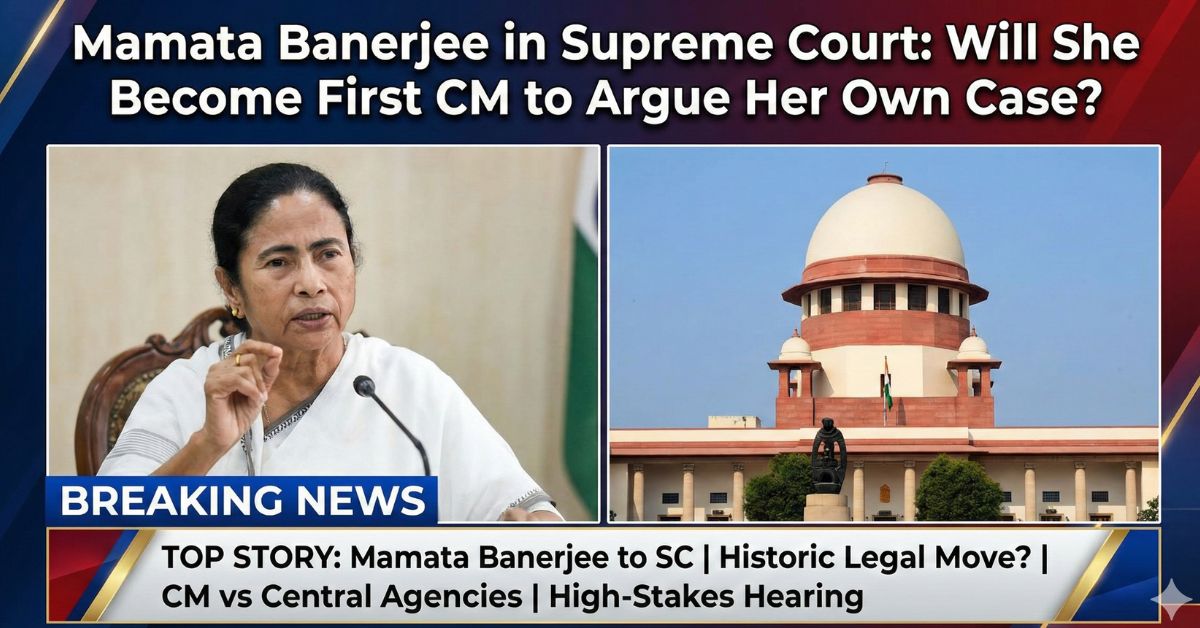
In a major political and legal development, West Bengal Chief Minister Mamata Banerjee has arrived at the Supreme Court in New Delhi today (February 4, 2026). Reports suggest she might personally argue her case against the Election Commission of India (ECI). If she does, she could become the first sitting Chief Minister in India’s history to argue their own case inside the apex court.
This dramatic move comes just a day after a heated confrontation with election officials, where she walked out of a meeting claiming she was “insulted and humiliated.” The conflict centers on the “Special Intensive Revision” (SIR) of voter lists in West Bengal ahead of the crucial 2026 Assembly Elections.
What is the “SIR” Controversy?
The core of the issue is a process called Special Intensive Revision (SIR). This is an exercise conducted by the Election Commission to update voter lists (electoral rolls). The goal is to remove the names of voters who have died, shifted residence, or are fake, and to add new eligible voters.
However, Mamata Banerjee and her party, the Trinamool Congress (TMC), allege that the process is flawed. They claim that the ECI is using “arbitrary” rules to delete the names of lakhs of genuine voters, especially from poor and marginalized communities.
One specific rule causing trouble is the “Logical Discrepancy” check. For example, if the age gap between a voter and their parent in the records is too small (less than 15 years) or too large, the system flags it. Mamata Banerjee argues that instead of correcting these clerical errors, the ECI is simply deleting these voters from the list, calling them “dead” or “fake.” She fears this will deny legitimate citizens their right to vote in the upcoming 2026 elections.
Read more: DSSSB Recruitment 2026 Update
“Insulted and Humiliated”: The Clash with the Election Commission
Before moving the Supreme Court, the West Bengal CM tried to resolve the issue directly with the Election Commission. On February 3, 2026, she led a delegation to meet Chief Election Commissioner (CEC) Gyanesh Kumar in Delhi.
The meeting did not go well. Mamata Banerjee walked out after just an hour, visibly angry. Speaking to the media later, she said, “We were insulted, disrespected, and humiliated. I have never seen this kind of CEC. He is very arrogant.”
She accused the Election Commission of acting like a tool of the central government (BJP) and compared the CEC to former West Bengal Governor Jagdeep Dhankhar. She stated that the Commission officials were not interested in listening to the grievances of the “victims” of the SIR process.
A Poetic Protest
Known for her cultural interests, Mamata Banerjee has also taken her protest to the literary world. She has reportedly penned a new book of poems titled “SIR: 26 in 26.”
The collection contains 26 poems that express her anger and sadness over the voter revision process. The poems highlight the pain of citizens who find themselves suddenly “erased” from the democratic process. This book was released recently at the Kolkata Book Fair and is being used to highlight the issue emotionally, beyond just legal arguments.
Why This Matters for 2026 Elections
The timing of this legal battle is critical. West Bengal is heading for Assembly Elections later in 2026.
- For TMC: They fear that if lakhs of their supporters are removed from voter lists, it could cost them the election.
- For Opposition (BJP): They support the SIR process, claiming it is necessary to remove “fake voters” and “illegal infiltrators” from the lists to ensure a fair election.
If the Supreme Court does not stop the current process, the final voter list will be published soon. Mamata Banerjee wants the court to order the 2026 elections to be held using the old 2025 voter list, ensuring no one is wrongly deleted.
What Happens Next?
All eyes are now on Courtroom No. 1 of the Supreme Court. A bench led by Chief Justice of India (CJI) Surya Kant is hearing the petitions.
Mamata Banerjee has filed an application seeking permission to argue in person. Since she holds a law degree (LLB), she is technically qualified to do so. If the Chief Justice grants permission, the nation will witness a rare event: a Chief Minister standing at the lawyer’s podium to defend her state’s voters.
Frequently Asked Questions (FAQs)
Q1: Why is Mamata Banerjee in the Supreme Court?
She is there to challenge the Election Commission’s “Special Intensive Revision” (SIR) process, which she claims is wrongly deleting genuine voters from West Bengal’s electoral rolls.
Q2: What is the SIR process?
SIR stands for Special Intensive Revision. It is a drive by the Election Commission to update voter lists by removing dead or fake voters and correcting errors.
Q3: Can a Chief Minister argue a case in court?
Yes. If the person has a law degree and the court gives permission, they can argue their own case. Mamata Banerjee has a law degree.
Q4: When are the West Bengal Assembly Elections?
The elections are expected to be held in mid-2026.
Q5: What did Mamata Banerjee say about the Election Commissioner?
She called him arrogant and claimed he “humiliated” her delegation when they went to discuss the voter list issues.