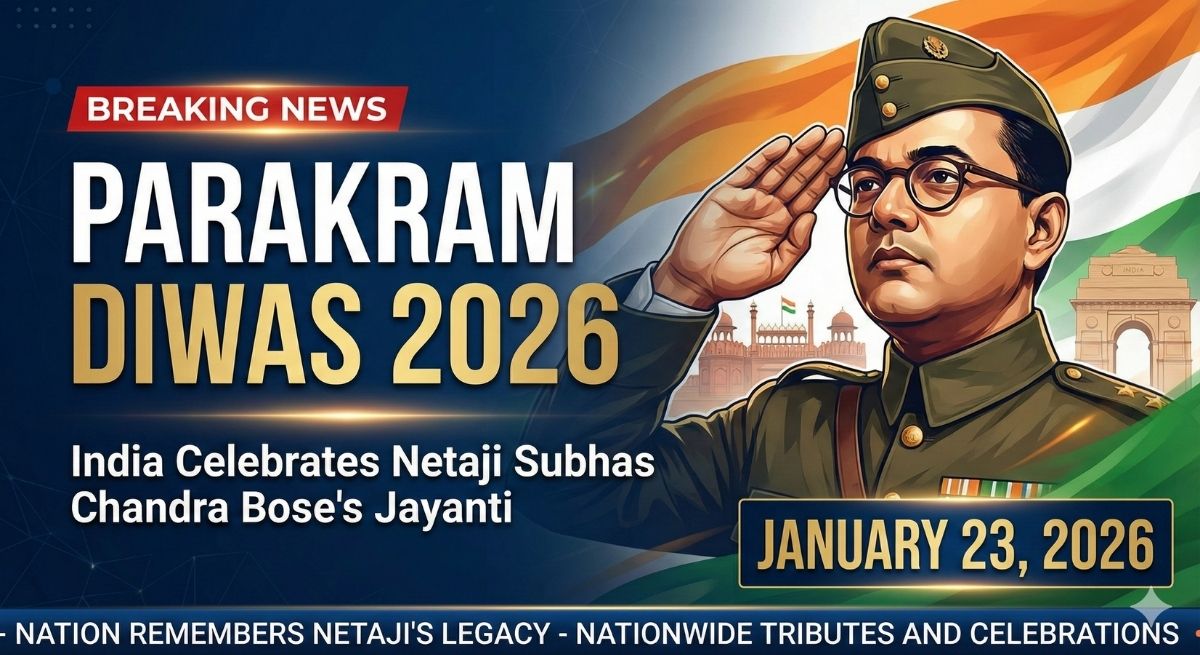
India is all set to observe a day of immense national pride and remembrance tomorrow. January 23, 2026, marks the birth anniversary of one of the country’s most iconic freedom fighters, Netaji Subhas Chandra Bose. This day is officially celebrated across the nation as ‘Parakram Diwas’ or the Day of Valor, to honor his indomitable spirit and selfless service to the motherland.
The government has planned a series of grand events to commemorate this special occasion, continuing the tradition of paying befitting tributes to Netaji’s legacy. From official ceremonies in the national capital to enthusiastic celebrations in his home state of West Bengal and beyond, the entire country will come together to remember the leader who gave the powerful slogan, “Give me blood, and I will give you freedom.”
Significance of Parakram Diwas
In 2021, the Government of India announced that January 23 would be observed annually as Parakram Diwas. The decision was taken to duly honor Netaji’s unparalleled contribution to India’s freedom struggle. The word ‘Parakram’ translates to courage or valor, reflecting the core characteristic of Netaji’s life and his defiant stand against colonial rule.
Celebrating this day is not just about looking back at history. It is an effort to inspire the youth of India with Netaji’s ideals of fortitude, national unity, and patriotic fervor. It serves as a reminder of the sacrifices made by countless freedom fighters under his leadership in the Indian National Army (INA).
Key Celebrations and Events Planned Across India
A host of programs are organized by the Ministry of Culture and various state governments to mark the occasion. The central focus of the official celebrations is usually in New Delhi and Kolkata.
In the national capital, top political leaders, including the Prime Minister and President, are expected to pay floral tributes at Netaji’s statue in the Parliament complex. Special functions are often held at iconic venues like the Red Fort, which has a deep historical connection with Netaji and the INA trials. The government may also organize cultural performances, exhibitions displaying artifacts related to Netaji’s life, and seminars to discuss his vision for India.
Focus on West Bengal and the North East
In West Bengal, Netaji’s birth anniversary is celebrated with tremendous emotional fervor. Large processions, known as ‘Prabhat Pheris’, are taken out in the morning in Kolkata and other districts. Schools, colleges, and local clubs organize flag-hoisting ceremonies and cultural programs featuring patriotic songs and plays based on his life. The state government also organizes official events to pay homage to its beloved son.
The North Eastern region of India, particularly places like Moirang in Manipur where the INA hoisted the tricolor for the first time on Indian soil, also sees significant commemorations. These events highlight the crucial role this region played in Netaji’s military campaign for India’s liberation.
Remembering Netaji Subhas Chandra Bose
Born on January 23, 1897, in Cuttack, Odisha, Subhas Chandra Bose was a brilliant student who cleared the competitive Indian Civil Service examination but resigned to join the freedom movement. He was a charismatic leader who rose to become the President of the Indian National Congress. However, ideological differences led him to chart his own path.
Netaji’s greatest achievement was the revitalization of the Indian National Army (Azad Hind Fauj) abroad. He built a formidable military force composed of Indian prisoners of war and civilians living in Southeast Asia. His ability to unite Indians of all religions, castes, and regions under a single banner against the British Empire remains an exemplary feat of leadership. His radio broadcasts from Berlin and Tokyo gave hope to millions of Indians back home during the darkest days of World War II.
Why Netaji’s Legacy Matters Today
More than seven decades after independence, Netaji Subhas Chandra Bose remains an enduring symbol of courage and patriotism in India. His life teaches the importance of having a clear vision, the courage to take bold risks for a greater cause, and the power of unity.
In modern India, Parakram Diwas is an opportunity to reflect on these values. It encourages citizens to contribute positively to nation-building and to stay united against any forces that threaten the country’s integrity. The extensive celebrations are a testament to the fact that Netaji continues to live in the hearts of nearly 1.5 billion Indians.
FAQs (About Parakram Diwas)
What is celebrated on January 23 in India?
January 23 is celebrated as the birth anniversary of Netaji Subhas Chandra Bose. The government has officially named this day as ‘Parakram Diwas’.
What is the meaning of Parakram Diwas?
‘Parakram’ means valor or courage. Therefore, Parakram Diwas is celebrated as the Day of Valor to honor the courageous spirit of Netaji Subhas Chandra Bose.
Is January 23 a national holiday in India?
While it is a significant day of national observance with many official programs, January 23 is not a gazetted national public holiday across the entire country, though some states like West Bengal declare it a public holiday.
How do schools celebrate this day?
Schools and colleges across India organize special assemblies, flag hoisting, patriotic song competitions, debates, and cultural programs to educate students about Netaji’s life and contributions.
When was Parakram Diwas first celebrated?
The first Parakram Diwas was celebrated on January 23, 2021, to mark the 125th birth anniversary of Netaji Subhas Chandra Bose.